Wave-Structure interaction
Cape Horn Engineering's simulations analyze response characteristics of ships and offshore structures operating in waves. We can simulate and predict:
- Global and local load to assess structural designs
- Green water loads on decks and superstructures
- Slamming loads: bottom, bow flare and wet-deck slamming
- Fluid motions in tanks to assess impact loads (sloshing)
- Fluid motions in well docks to assess operability
- Fluid motions in cargo decks of damaged ships to assess loss of stability
Amphibious transport dock vessel (2003)
An amphibious transport dock is a ship which features a docking well in the stern capable of launching landing craft and amphibious vehicles containing troops. The conditions in the docking well were analyzed in different sea states and ballast conditions for a variety of docking well designs. This project was completed in 2003.
Simulations of wave attenuation characteristics and dynamic responses of a floating breakwater in shallow water (2003)
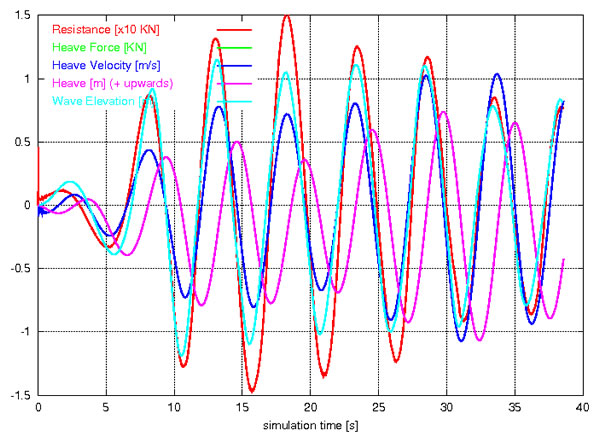
The performance of a floating breakwater in shallow water was investigated using our coupled RANS and body motion methodology. The breakwater consists of a rectangular pontoon and rigid keel-like membrane that is supported by sleeves on vertical piles. As a result the breakwater is only free to move in heave. The effectiveness of the breakwater was studied for a range of parameters and conditions including pontoon width and draft, membrane depth, incident wave height, wavelength, and water depth. Wave transmission coefficients, wave loads, and dynamic responses were computed from the results of these simulations.
The video animation shows one pontoon configuration in regular waves of 1.5 m height and 40 m length.
© 2013 Cape Horn Engineering. All Rights Reserved.