Resistance Tests
Normally separate tank tests and computer simulations are carried out for a discrete set of vessel speeds. At Cape Horn Engineering, when required, we are able to compute the the entire resistance curve in a single simulation. In this simulation the vessel starts at rest and then accelerates very slowly until it reaches the maximum speed of interest. The acceleration is small and the flow almost converges at each instant speed; the calculation can be considered quasi-static.
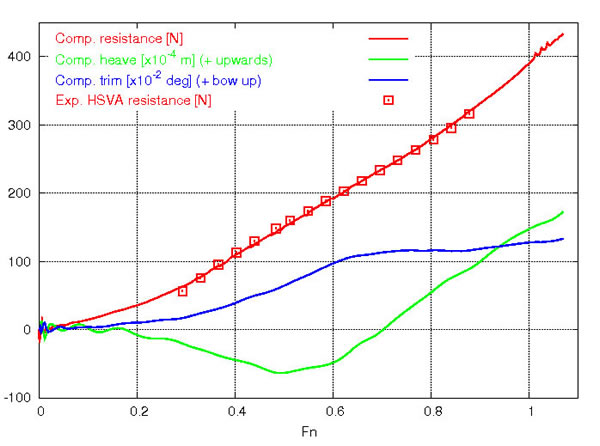
The diagram belwo shows the resistance curve of a Littoral Combat Ship computed from rest to a Froude number of 1.07. This corresponds to a full scale speed in excess of 70kn. However, there is no restriction in speed, similar resistance tests have been done up to Fn=4.
The red line in the diagram below is the resistance curve. The simulation also computes dynamic sinkage and trim across the entire Fn-range, the green and blue lines respectively. The red symbols shown are experimental data from the Hamburg Ship Model Basin (HSVA). The experiments were carried out 3 weeks after the simulation data had been given to the client, the agreement is very good.
The CPU time needed to compute the resistance curve is greater than a single speed calculation, but it becomes advantageous when many speeds are needed.
For more information on this methodology see ONR'04 article in Publications.
Other examples
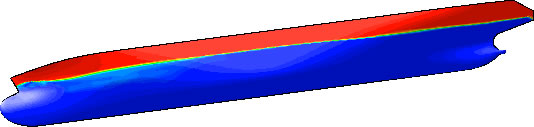
Free surface flow around a Container ship sailing at Fn=023. Full scale computation
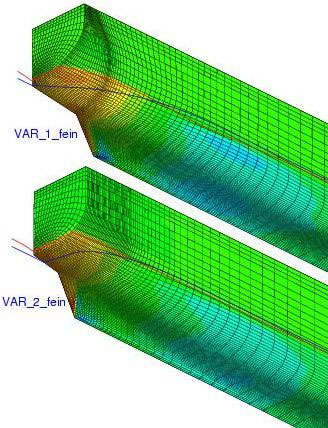
Pressure coefficient distribution for two slightly different sterns of a container ship. Blue line: waterline at rest, red line: wave profile
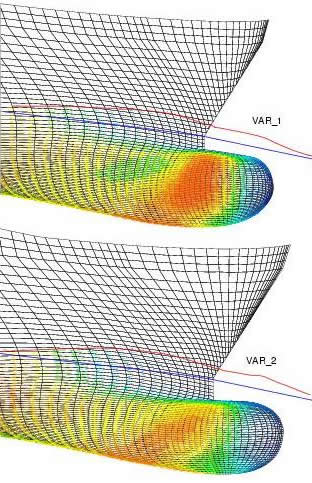
Computed distribution of the shear stress at the bow of the two variations of a container ship, Tau in N/m^2
© 2013 Cape Horn Engineering. All Rights Reserved.