Breaking Waves
- Computations with a very blunt bow ship model for which the bow wave breaks. Comparison with model tests. Grids of different fineness up to over two million to assess discretisation errors.
- Computations of hydrofoils working close under the free-surface under the influence of breaking waves.
Blunt bow model
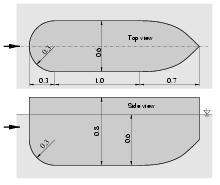
Sketch of the Blunt Bow Model
Instantaneous shape of the free surface ahead of the bow
Computed instantaneous free-surface elevation around the hull
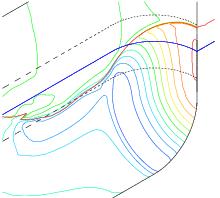
Computed instantaneous pressure distribution along the hull surface in the bow region
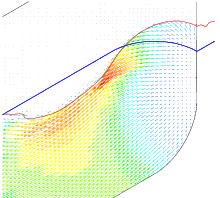
Computed instantaneous distribution of the shear stress along the hull surface in the bow region
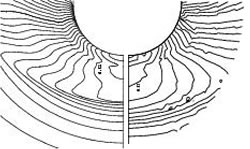
Time Average of the free-surface elevation ahead of the bow: measurements (right; courtesy of Ship Research Institute, Tokyo) and computations on the finest grid (left). Interval between lines 0.01 m.
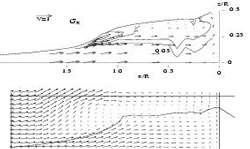
Average wave profile and velocity vectors measured in the symmetry plane ahead of the bow (above) and the simulation on the finest grid (below); (measurement data courtesy of Ship Research Institute, Tokyo)
Hydrofoil

Computed free-surface shapes at three time instants about one second apart, for a foil speed of 1.5 m/s, submergence depth of 14% of the chord and angle of attack of 5°
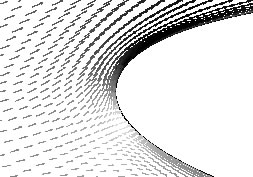
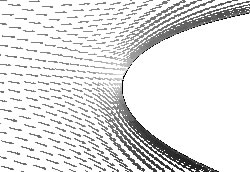
Computed velocity field around the hydrofoil nose in deep water (left) and under the free surface (right) at the speed of 1.5 m/s and angle of attack of 5°
© 2013 Cape Horn Engineering. All Rights Reserved.