Appendage optimization
In appendage optimization we look for the best combination of appendage shape, size, and position. Variables include profile section, thickness to chord ratio, planform, rake, sweep angle, twist, tip shape, and fairing shape.
Simulations offer the following tools for appendage optimization:
- Assessment of steady or unsteady forces and moments
- Analysis of load distribution along span and chord
- Assessment of the effective angle of attack. This is largely influenced by the free surface and trim of the boat. In our experience, the omission of these two factors i.e. in wind tunnel tests, leads to incorrect design conclusions
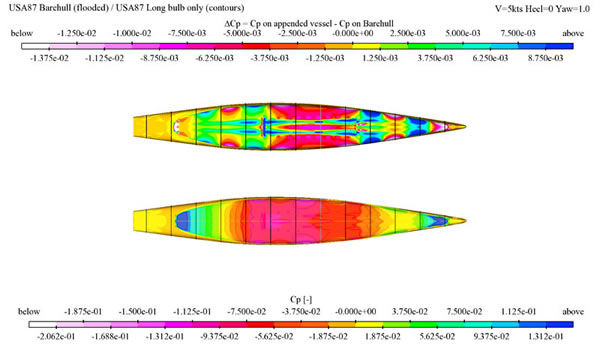
- Interference drag calculation
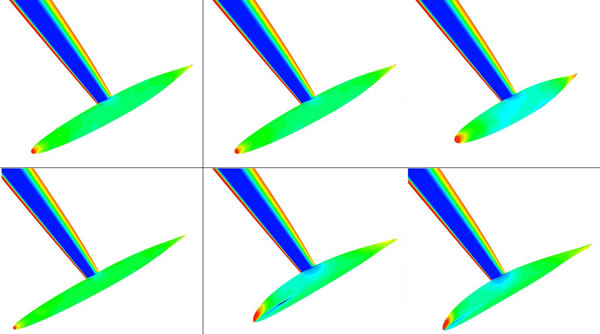
- Prediction of flow separation and vorticity
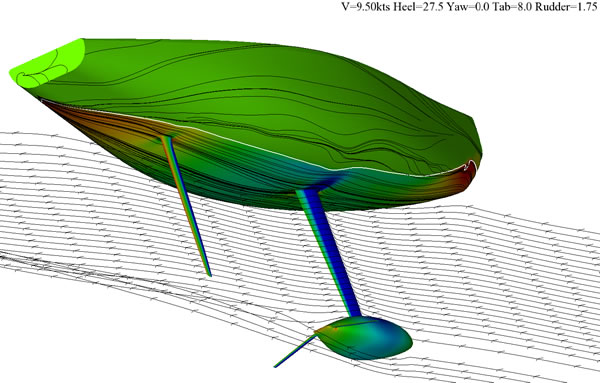
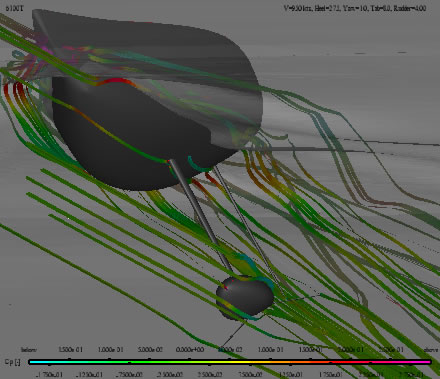
- Visualization of particle traces, stream lines, velocity profiles and upwash due to the presence of the appendage
- Characteristics of an appendage undergoing unsteady motions, even propulsive effects of flapping foils
We are able to investigate many types of appendages:
- Rudders, dagger boards, fin keels with or without tabs, bulbs, winglets
- Spray rails
- Trim tabs, interceptors and wedges
- Hydrofoils
- Stabilizers
- Others...
Are simulations better than the wind tunnel for appendage design?
Unconventional designs
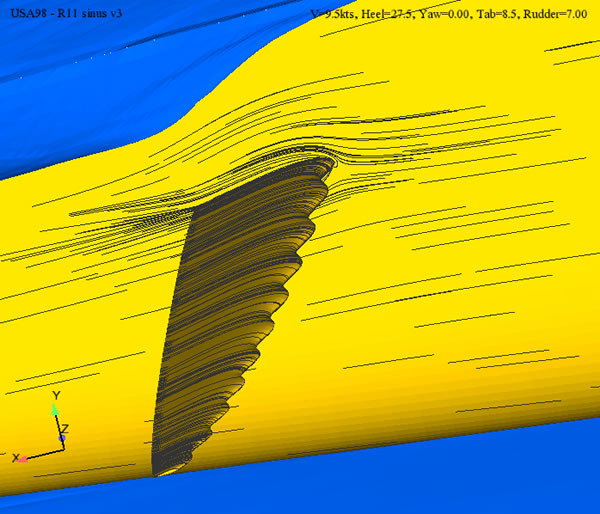
Flow separation
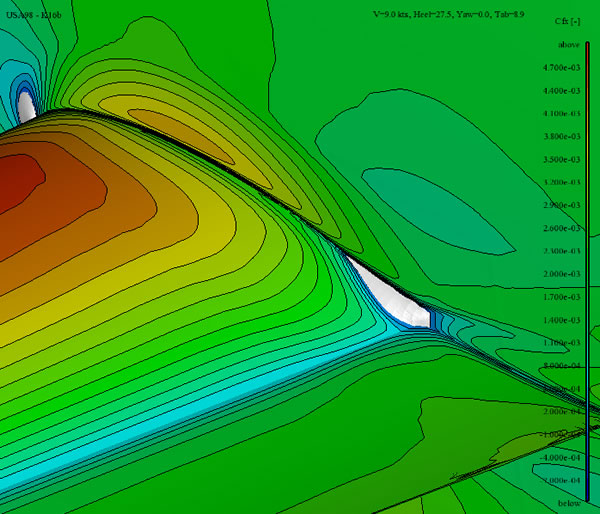
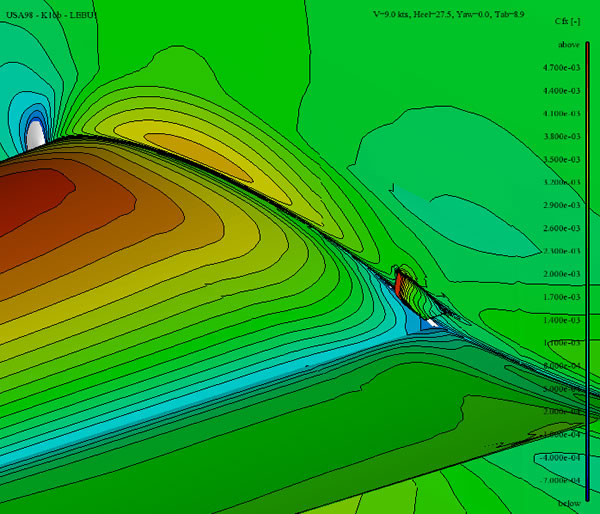
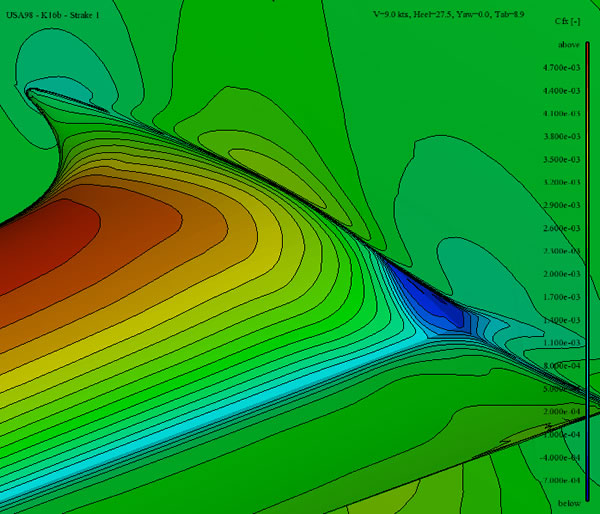
Appendage placement and orientation
Vorticity
Interference drag
Flapping foil propulsion
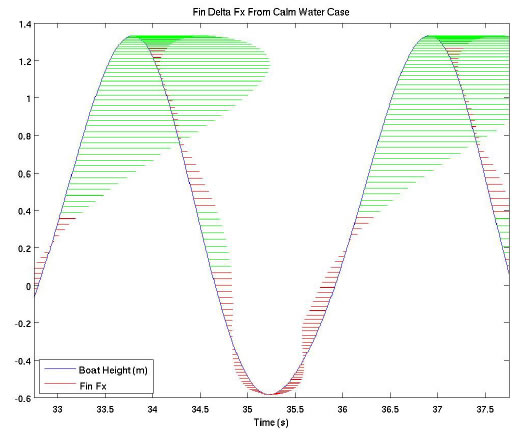
Yacht motions in short steep waves cause appendages to experience oscillating effective angles of attack and heave. Our investigations have shown that depending on specific characteristics of the motion, this results in reduced drag, or even a net propulsive force.
In this diagram the nearly sinusoidal blue curve represents the heave motion of the boat, and each horizontal line (red or green) is the relative longitudinal force on the foil. The calm water case is taken as the baseline. Any horizontal line extending to the right has less drag than the calm water case, and lines to the left have more. Red lines indicate a net drag force, while green lines indicate a net propulsive force.
Bulb optimization
© 2013 Cape Horn Engineering. All Rights Reserved.