Example of seakeeping simulations in America's Cup yacht design
In the BMW Oracle Racing Challenge 2007 and the current Team Origin campaign we performed simulations of yacht performance in regular waves for several design candidates. The yachts were fully appended and the simulations were run at full scale. In general, the yachts were allowed to move freely in heave and pitch. In some cases it was also interesting to look at roll and sway motions. The wave characteristics and sailing conditions were chosen to represent typical sailing conditions, both upwind and downwind. At the same time, calm water simulations were performed with the same computational mesh to establish a reference. The force averages were obtained over the last motion period and compared to the calm water forces.
The computational effort required for each simulation in waves is comparable to simulations in calm water, this allows us to compute a large matrix of variations if required.
The tipical results of simulations in waves are:
- Added resistance over the calm water case
- Maximum and minimum pitch and heave values
- Forces, moments, and centers of efforts for the complete yacht and for each appendage
- Visualization in the form of video animations of the free surface, breaking waves, sprays, pressure, and friction coefficients, etc
AC 90
AC 90 beating to windward at 12 knots, heeled 30 degrees, with waves coming at an angle of 30 degrees from the course line. Left: wave height 0.5 m, wave length 5 m, middle: height 1 m, length 10 m, right: height 1 m, length 20 m.
Version 5 ACC Yachts
Version 5 ACC yacht sailing upwind in oblique waves of 0.5 m height and 24 m length
Same yacht sailing in oblique waves of 1 m height, viewed from below the water plane
Version 5 ACC yacht sailing downwind in oblique waves coming at an angle of 30 degrees from the stern. Wave height is 0.5 m and length 40 m
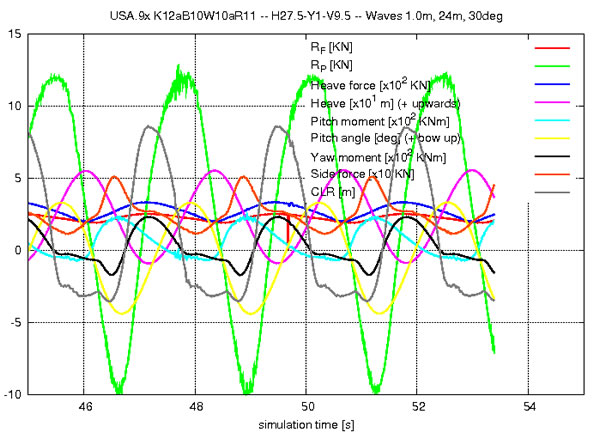
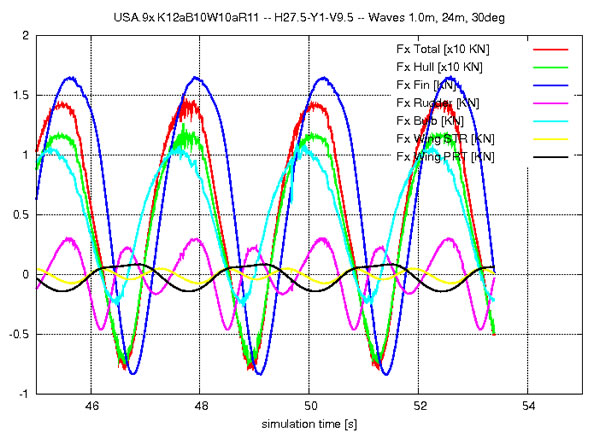
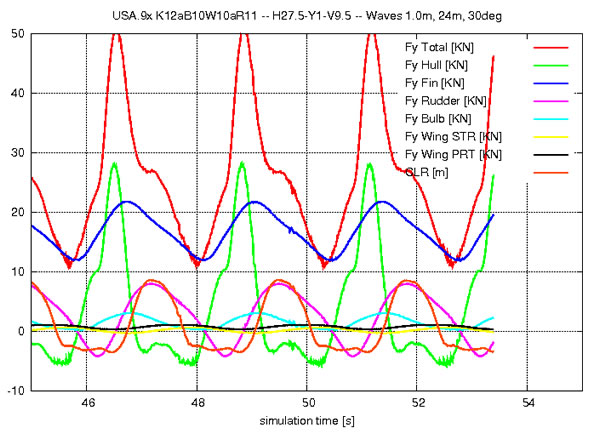
The diagrams below show the time history of some selected values over the last 4 wave periods for a typical case: The first diagram shows total values for friction and pressure drag, the heave and pitch motion, vertical and side force, pitch and yaw moments, and position of the center of lateral resistance. The next two diagrams show the drag and side forces for the different components of the yacht, hull, fin, bulb, rudder and winglets.
© 2013 Cape Horn Engineering. All Rights Reserved.